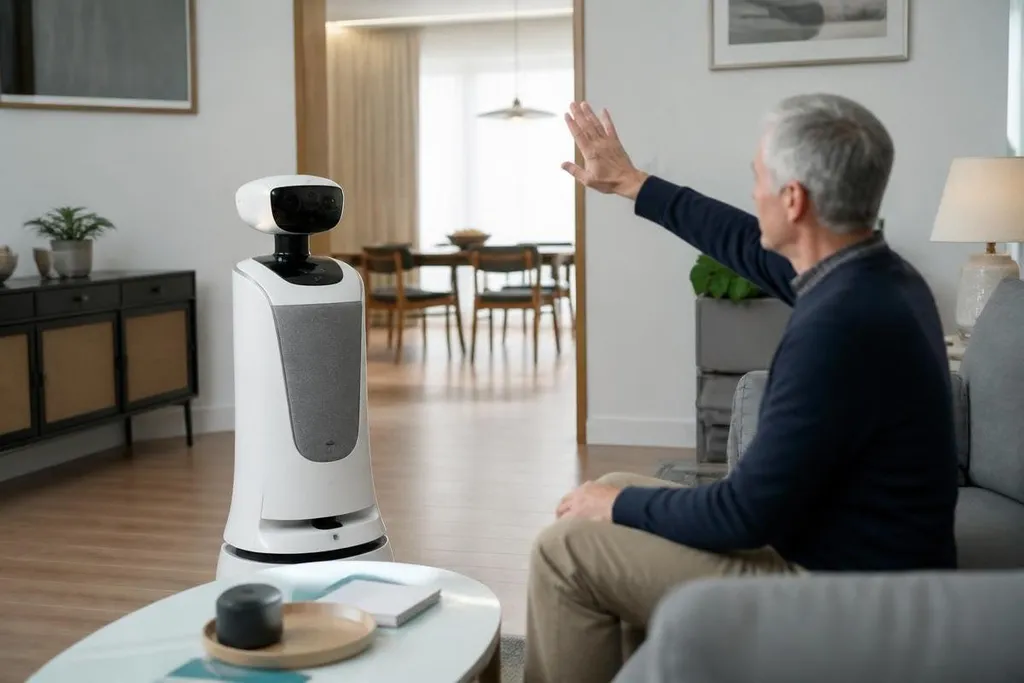
A social robot may need to tell the difference between a person waving, reaching, or asking for help. It can only do that by combining signals from cameras, microphones, touch sensors, and its own record of what happened before.
This matters in care homes, public spaces, schools, and homes, where a robot must respond to people instead of repeating a fixed script.
- Body movement: pose, direction, speed, and distance
- Speech and sound: words, volume, pauses, and background noise
- Context: what happened before and what the person is doing now
The signals a robot can read
A camera can track body position and hand movement. This process, called pose estimation, turns an image into points that describe the head, shoulders, arms, and legs. The robot can then compare those points over time.
Movement alone rarely gives a complete answer. A person leaning forward may be trying to hear someone, pick up an object, or leave a seat. The robot needs more information before it chooses a response.
Microphones add speech, tone, and pauses. Speech recognition can turn words into text, while sound analysis can help separate a request from background noise.
Touch sensors can add another signal when someone presses a button, takes the robot’s arm, or moves an object near it. These inputs arrive with different levels of confidence.
A camera may lose sight of a hand, and speech recognition may misread a word in a noisy room. A safe system should keep that uncertainty instead of acting as if its first guess is correct.
Context changes the meaning
Human behavior gets its meaning from what came before. If someone asks for directions after looking at a map, the robot has more context than it would from the same words heard during a conversation.
Recent events can be stored as a short sequence. The robot may record that a person approached, looked toward a display, pointed at a door, and spoke. Each event adds information, but the sequence still does not prove what the person wants.
This is where the robot’s action matters. It can ask a short follow-up question, point to two choices, or wait for another signal. Asking can be safer than guessing, especially when the next action affects a person’s movement, privacy, or access to care.
The robot also needs a model of the setting. A gesture that works in a classroom may mean something different in a station or a home. Distance matters too. Standing close may help a hard-of-hearing person, but it may make another person step away.
A social robot’s response is easier to judge when a report names the gesture, setting, robot model, and result. Robot24.com can give you that record before you decide whether the system reads a person or matches a narrow test.
Where the system can fail
The hardest problem is ambiguity. People use indirect language, change their minds, and show emotion in different ways. A robot trained on one group may read another group’s gestures poorly.
Privacy adds a second limit. Cameras and microphones can collect sensitive information even when a robot is only trying to answer a basic request. A useful design should state what it records, how long it keeps that data, and who can access it.
There is also a gap between detecting behavior and understanding intent. A robot can identify that a person is moving toward a door without knowing whether they plan to leave, open it, or help someone nearby. That gap grows when several people speak or move at once.
I’d treat any claim that a social robot understands people as a claim about a narrow task, not human understanding in general.
A buying and testing checklist
Before you choose or trial a social robot, check these points:
- Name the task: Write down the exact behavior the robot must detect.
- Test the setting: Use the real room, lighting, noise, clothing, and distance.
- Measure wrong guesses: Record false alarms, missed requests, and follow-up questions.
- Check human control: Give a person a clear way to stop or correct the robot.
- Review data handling: Ask what the sensors record, where it is stored, and when deletion occurs.
- Set a fallback: Decide what the robot does when its confidence is low.
The system becomes useful when its limits are visible and its responses stay safe under uncertainty. The next test is simple to state: can it ask for clarification at the right moment, before a wrong guess creates a problem?